Jannik Sinner, of Italy, executing a picture-perfect backhand volley against Holger Rune, of Denmark, at the 2022 ATP Sofia Open tournament in Sofia, Bulgaria
Should tennis allow only one serve to solve the power crisis?
In 1920, superstar “Big Bill” Tilden, renowned for his cannonball serve, predicted the second serve would soon be abolished because the serve had become so dominating.

Later in the 20th century, Neale Fraser, the three-time Grand Slam singles champion and 24-year Australian Davis Cup captain, former British star Bunny Austin, and former ITF president Philippe Chatrier contended this rule change would redress the offensive-defensive imbalance on the pro tour.
"It’s so simple, really. Let them have only one serve,” Fraser told The Telegraph (UK) in 1994. “Why give guys a second chance of winning the point with equipment, which is so advanced in a way that those who started the game could never have envisaged?”
The proposed one-serve rule change gained momentum this century. When Socrates Magazin asked Rafael Nadal in 2018 about rules that should change in tennis, he replied, “Players are getting bigger, and the serve becomes even faster. If in the next years you will not find a good solution, I am afraid that in the future, sports will be only about power. And it could be dangerous.” The King of Clay thought abolishing the second serve merited at least an experiment, saying, “It would not be a silly idea. You just have to try and see if this rule is right. You may introduce new rules in little tournaments.”
This March, Patrick Mouratoglou, who coached Serena Williams to 10 of her 23 Grand Slam singles titles, told Le Monde (France), “What solves the problem is having only one serve. I think what we did at UTS [Ultimate Tennis Showdown, an exhibition event]—having only one serve instead of two—solves the issue. We have many more rallies, far fewer aces and serve winners, which is what we want. We want more rallies and less… boom, serve, winner, ace, missed return… we don’t want that. We want to see rallies. Having an ace once in a while is fine, but not too many.”
Would doing away with the second serve in tennis make the game more entertaining?
Matthew Ebden, former world No. 1 in doubles, believes such a rule change would have the opposite effect. “No, because that would actually do away with the first serve,” explained Ebden. “It would take away a lot of the strategy in serving, because with one serve on each point, it would be used just to start the point. Pounding the serve would be a bad idea because a miss gives the point to the opponent. It would cause return games to suffer because the pressure is off the returner. Pressure is what hones skill. Tennis has great returners like Djokovic, Murray, Ferrer, Nadal, Nishikori, and Hewitt because of the pressure put on the returners in today's game. Tennis would suffer a lot with no first serve. Serving shouldn't change.”
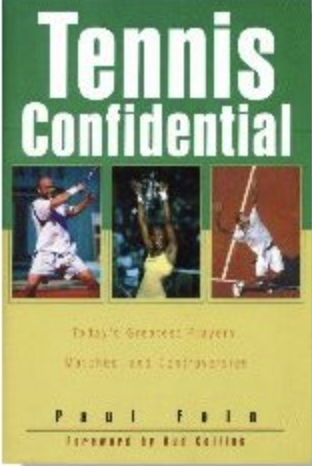
In my 2002 book, Tennis Confidential: Today’s Greatest Players, Matches, and Controversies, I wrote: “They’re [Fraser, Chatrier, and Austin] right—although today’s serving crisis is confined to the men’s circuit, and even there, mainly on grass and fast indoor courts.
"While a one-serve rule would solve one problem, its ‘overkill’ would create three new serious problems. First, virtually every pro would resort to serving safe, high-arcing, kick serves all the time for fear of single faulting. The emasculation of the serve would end first serves and also produce a boring sameness of spin serves.
"Second, every “single fault” would result in the outright loss of a point, and singles faults would far exceed the number of double faults that players previously committed. This drastic change would frustrate players, create fewer played-out points, and result in even more “dead time.”
"Third, and most important, is the hitherto undiscussed dilemma our sport would face. Should the one-serve rule extend beyond the pro tour (or tours) to the entire tennis world?
"A one-serve rule would prove totally impractical and, in fact, destructive for the millions of recreational players worldwide. Many of them now struggle to get even a modest percentage of their first serves in at any speed. They absolutely need two serves. Otherwise, they would “single fault” points away almost every game. And that ineptitude—or inconsistency, to put it kindly—would ruin their enjoyment of the game. And yet two drastically different, coexisting rules for serving won’t work either.
"This dilemma provides a clear and valuable lesson that illuminates the 'change vs. tradition' debate from yet another important angle: The rules for the pro sport should differ in degree but not in kind from the amateur game, with rare exceptions."
All things considered, my conclusion hasn’t changed since 2002.
I rest my case. The verdict is yours.
Paul Fein — May 8, 2025
Other Books by Paul Fein